
Find out what is relevant for you.
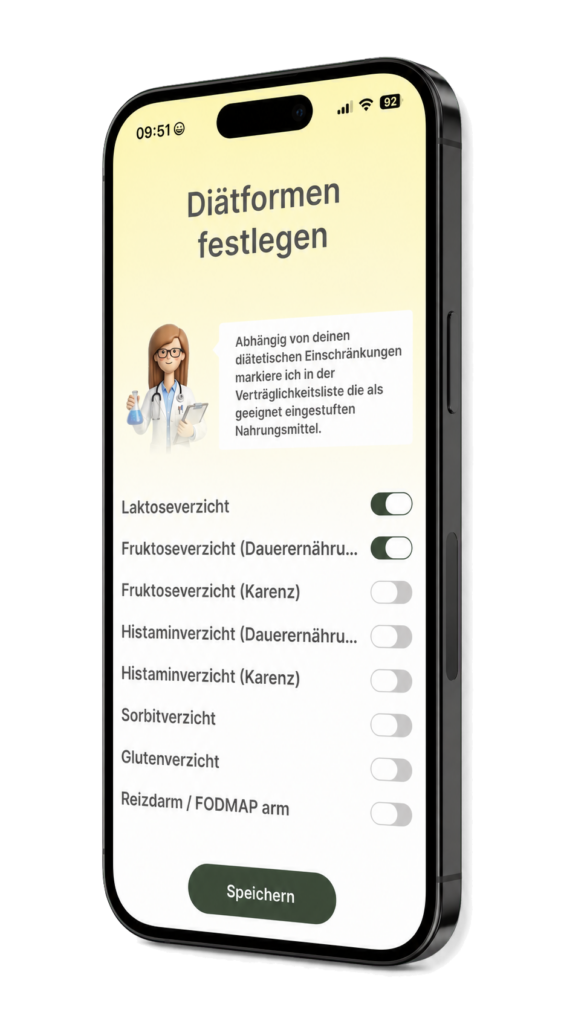
Not all foods are tolerated equally by everyone. Ask Ingrid helps you to clearly organize information on various dietary approaches. In the app, select the topics that are important to you. Foods and products will then be displayed based on your personal selection.
Fructose
Fructose occurs naturally in fruits, vegetables, and other foods. It is also added as a sweetener to many processed products.
In Ask Ingrid, you can distinguish between the elimination phase and long-term diet and view relevant information on fructose, sorbitol, and glucose.
Histamine
Histamine is a natural messenger substance and can occur in varying amounts in foods. However, in histamine intolerance, several biogenic amines play a role. The content of these biogenic amines can be influenced by storage, ripening, and processing, among other factors.
Ask Ingrid helps you to clearly categorize foods based on the available information. You can choose between the elimination phase and long-term diet.
Lactose
Lactose is natural milk sugar. It is broken down in the small intestine by an enzyme, lactase. If there is insufficient lactase in the small intestine, lactose can only be broken down to a limited extent.
Ask Ingrid shows you information on the lactose content of foods and helps you find suitable alternatives.
Sorbitol
Sorbitol is a sugar alcohol that occurs naturally in certain fruits but is also used as a sugar substitute.
With Ask Ingrid, you can find foods and ingredients where sorbitol might be relevant for your personal selection.
Gluten
Gluten is a protein component of various grains. People may avoid gluten-containing foods for various reasons. Ask Ingrid helps you with this.
Ask Ingrid is not intended for the treatment or safe food selection for celiac disease. Celiac disease requires a medically supervised, strictly gluten-free diet.
FODMAP
FODMAP is a collective term for certain fermentable carbohydrates. These include fructose, lactose, or sucrose, among others.
A low FODMAP diet is often time-limited and carried out under professional guidance, mostly for irritable bowel syndrome patients.
Ask Ingrid offers additional guidance in selecting foods.
INFORMATION THAT MATCHES YOUR SELECTION
In the app, you determine which dietary approaches are relevant to you. Ask Ingrid then presents the available information according to your selection.
How reactions to foods are classified

Select a box to highlight its path. Drag to pan; use the mouse wheel or plus and minus keys to zoom.
TOLERANCE IS INDIVIDUAL
People can react differently to the same food. Quantity, preparation, ripeness, and personal situation can also play a role. The information in Ask Ingrid serves as guidance and does not replace a diagnosis, medical treatment, or individual nutritional counseling. Symptoms should be clarified by a doctor or a qualified nutritionist.